
.png)
For more than two decades, enterprise software has followed the same basic formula. Build dashboards. Add reports. Create menus. Train users to navigate them.
The result has been generations of software that require users to learn the system before the system can help them.
But something is changing.
The world's largest technology companies are all moving in the same direction. Apple, Google, Microsoft, OpenAI, and Amazon are investing heavily in a future where users interact with software through conversation instead of navigation.
Rather than opening an application, clicking through menus, filtering reports, and searching for information, users simply ask a question. The software responds. In some cases, it may even complete the action automatically.
For industries built around mobility, field work, and real-time decision-making, the implications are enormous. And few industries fit that description better than insurance claims.
01 / The Proof
Apple Just Showed What This Looks Like
You don't have to imagine this future. Apple put it on stage.
At WWDC 2026 on June 8, Apple introduced Siri AI—an entirely new version of its assistant powered by Apple Intelligence. The company described it as profoundly more capable and conversational, with personal context understanding, broad world knowledge, and onscreen awareness. In plain terms: an assistant that knows what's on your screen, can pull from your own messages, emails, and photos, and can answer questions on virtually any topic without you hunting for the answer yourself.
But the more interesting part isn't the assistant. It's where it lives.
The new Siri is no longer buried inside a single feature. It works across apps, and it now exists as its own standalone app on iPhone, iPad, and Mac—able to revisit past conversations, act on what's onscreen, and carry context from one place to the next. Apple even demonstrated its Passwords app using Apple Intelligence to agentically take action on a user's behalf, visiting websites to fix insecure passwords automatically.
That is the entire thesis of this article, shipped by the world's most valuable device maker.
Adoption here isn't driven by a new dashboard. It's driven by the device.
Apple isn't asking a billion people to learn new software—it's putting conversational intelligence directly into the phone, the watch, the tablet, and the laptop people already carry. The hardware is the distribution. When the assistant is built into the device itself, adoption doesn't require training. It requires nothing more than speaking.
For an industry whose workforce lives on mobile devices in the field, that detail matters enormously.
02 / The Premise
The Claims Industry Was Never Built for Desktops
Think about where work actually happens. Adjusters are inspecting roofs. CAT teams are deployed across multiple states. Managers are traveling between meetings. Executives are reviewing operations from mobile devices.
Yet much of the technology supporting these workflows still assumes users are sitting at a desk in front of a computer. That disconnect becomes more obvious every year.
The modern claims professional does not need more reports. They need faster answers.
03 / The Shift
The Rise of Conversational Intelligence
Historically, finding information required knowing where to look. Want to understand vendor performance? Open a dashboard. Run a report. Apply filters. Export data. Review results.
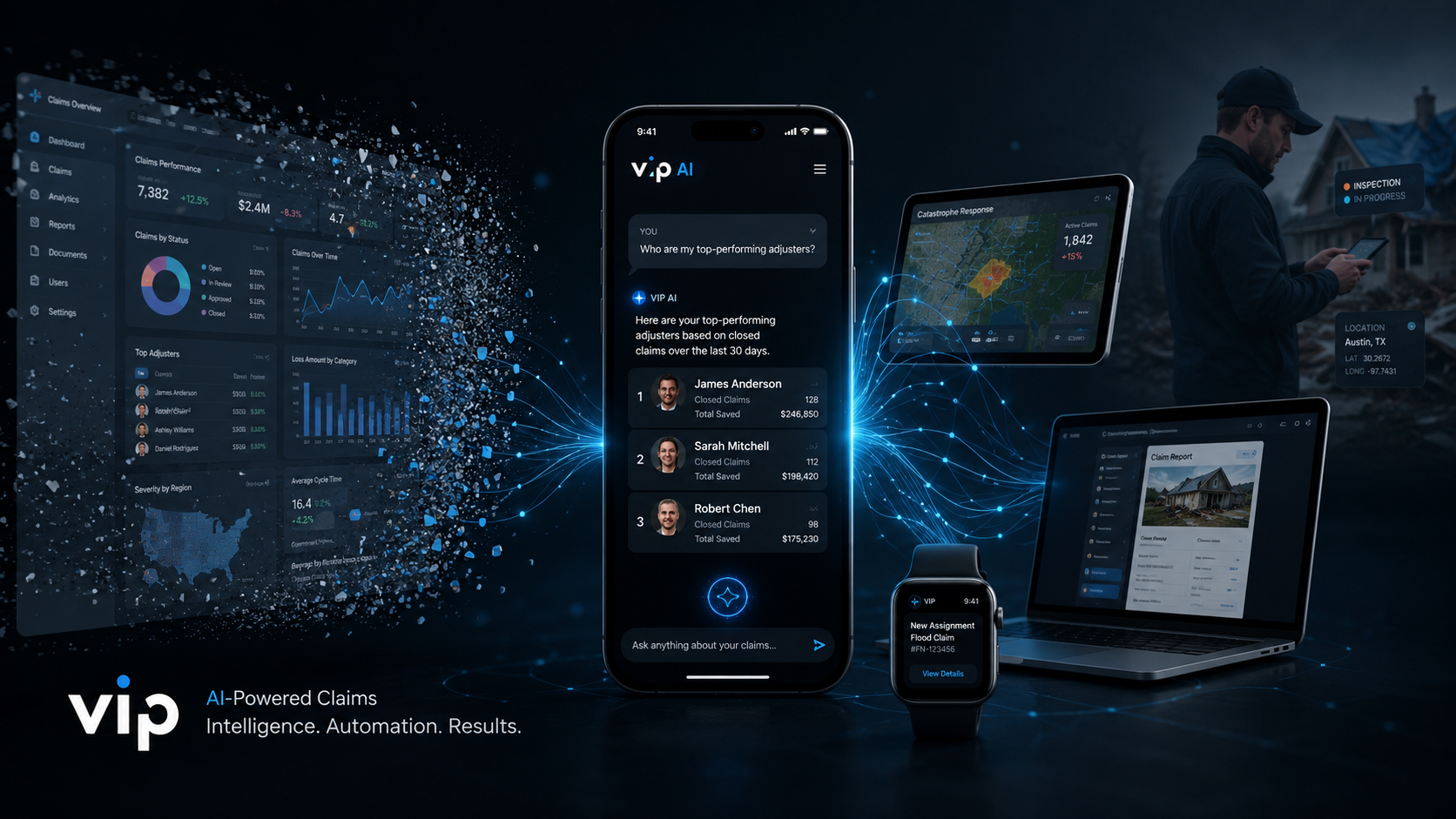
The next generation of software is turning that process upside down. Instead of learning software, users simply ask:
Just ask
- Who are my top-performing adjusters?
- What regions are experiencing the highest deployment activity?
- Which invoices remain unpaid?
- How are catastrophe events affecting costs this month?
The system handles the complexity behind the scenes and returns an answer in seconds. The experience feels less like operating software and more like having a conversation with someone who already knows the answer.
04 / The Channel
Voice Is Becoming a Business Tool
Voice technology has existed for years, but recent advances in artificial intelligence have changed expectations. People now speak naturally to their devices every day. What was once considered a consumer convenience is rapidly becoming a business productivity tool.
For claims professionals, the opportunity is particularly compelling. A field adjuster shouldn't need to stop what they're doing to type a question. A manager shouldn't need to wait until they return to a desk to find critical operational information.
The ability to simply ask and receive an answer may become one of the most important shifts in enterprise software adoption over the next decade.
05 / The Next Step
Beyond Search
The evolution doesn't stop with finding information. The next phase is action. The same systems that answer questions will increasingly be expected to complete tasks.
.svg)
The line between software and assistant continues to blur.
06 / The Hardware
Looking Beyond Today's Devices
This shift is not only about artificial intelligence. It is also about the devices themselves. As mobile computing evolves and new device categories emerge, traditional desktop workflows become less central to everyday work.
The future may involve foldable devices, tablets, wearables, vehicle interfaces, or technologies that have not yet reached the mainstream.
What matters is not the screen. It is the interaction.
The keyboard is becoming less important. Menus are becoming less important. Conversations are becoming more important.
07 / The Horizon
The Next Decade
The dashboard is not disappearing tomorrow. Reports will continue to matter. Analytics will continue to matter. But the primary interface between humans and software is changing.
The companies that thrive in the next decade may not be the ones with the most screens. They may be the ones that make those screens unnecessary.
The future of enterprise software is becoming less about where the information lives and more about how quickly people can access it.
.avif)
%20(1).avif)
.avif)